Michael Spyres on a Century of Roles and the Magic of Expanding Boundaries
Some conversations take time to find their rhythm, others seem to take off almost immediately. We had barely sat down in a café overlooking the Vienna State Opera before the discussions wandered from construction sites in the Ozarks to Rossini, forgotten composers, Michael Jordan, and the curious realities of life on the international stage. Stories flowed freely, often accompanied by laughter and unexpected detours, while even the simplest questions opened onto broader reflections about art, history, and human nature.
Yet what made the encounter so engaging was not simply its range, but the openness with which Micheal Spyres approached every subject. A celebrated baritenor, scholar of forgotten repertoire, and interpreter of roles ranging from Rossini to Wagner, he remains remarkably free of pretension and still approaches opera with the enthusiasm of someone discovering it for the first time.
As the conversation moved from topic to topic, one idea kept surfacing beneath all the others: an insatiable curiosity about people, music, and the possibilities that exist beyond accepted boundaries.
The image many people associate with an internationally celebrated opera singer rarely includes construction sites. Yet construction was part of Spyres’s life long before opera became a profession. His grandfather was a mason who taught him practical skills from an early age, and when the pandemic brought performances to a halt, he found himself back on building sites, carrying cement and working alongside friends much as he had in his youth.
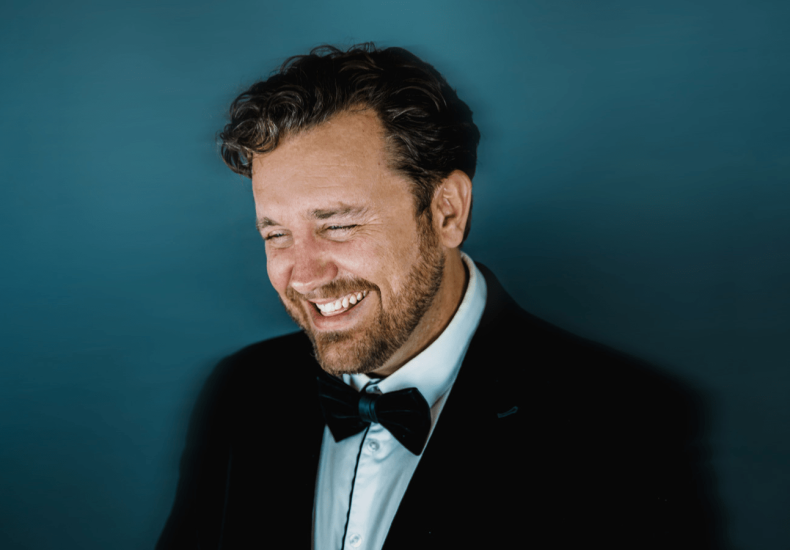
Born into a family of music teachers in one of the poorest regions of the Missouri Ozarks, Spyres grew up in a world where music formed part of everyday life. Folk songs, country music, church choirs, and recordings of Enrico Caruso existed naturally side by side. Neighbours came to listen to opera records before singing folk songs on the porch together. Opera was simply another form of musical expression and, as Spyres would later put it, “opera belongs to everyone. For us it was the pinnacle of human thought and existence coming together.”

Photo©Andie Mae, Designing Indie
His earliest musical education came through the local church choir directed by his father, which became his first musical laboratory. Bored by singing the same part week after week, he began moving freely between bass, tenor, alto, and soprano lines, experimenting with different sounds and discovering how dramatically a voice could be transformed.
There was also a more personal connection to opera. Spyres was named after an uncle who had dreamed of becoming a singer but died young before that dream could be realised. The family story did little to persuade him to follow the same path at the. As a teenager he was more interested in cartoons and voice acting.
By eighteen, a different ambition had begun to take shape. “I want to see the world,” he remembers thinking. Growing up in the rural Ozarks, distant European cities seemed unimaginably far away, and he began to wonder whether singing might offer a path beyond the world he knew. Even opera felt remote; the nearest company was several hours away, and chorus rehearsals meant an hour’s drive each way.
The answer came at nineteen, when he travelled to Europe with his college choir. Crossing the continent by train with a backpack and guitar, looking more like a hippie than a future opera singer, he discovered that opera was no longer an abstract dream but a living profession. Every city seemed to have its own opera house, audience, and tradition. “Wow, so people are actually doing this for a real living,” he recalls thinking. “Maybe I should take this really seriously and see if I can become an opera singer.”
Returning to the United States, he threw himself into vocal studies. But when a teacher who had strongly encouraged him left academia, the path forward suddenly became uncertain. Auditions for conservatories and young artist programmes brought little success, while financial realities made the situation even more difficult. At twenty-one, Spyres left university, returned home, and made a decision that would shape the rest of his career: he would learn to sing on his own.
For the next two years he worked as a construction worker during the day and studied singing at night. Armed with a tape cassette and an unusual degree of determination, he developed a system of self-evaluation: each evening he recorded himself; the following day, while carrying cement, he listened back and analysed. What worked was kept. What did not was discarded.
Teachers recognised both tenor and baritone qualities in his voice but struggled to say exactly what it was. One suggested he might become a dramatic tenor in twenty years. “So what do I do for twenty years?” Spyres asked. Nobody had a satisfying answer.
So he began searching for his own answers. Historical treatises by Manuel García and Francesco Lamperti sat alongside books on anatomy, physiology, and acoustics. Singing had become an intellectual pursuit. If he wanted to sound like a particular tenor, he wanted to understand the biological and acoustic mechanisms behind the result.
That search eventually brought him back to Europe. Selected for the World Youth Choir at twenty-one, Spyres formed friendships with young musicians from across the continent. Those ties first drew him to Germany and eventually to Vienna, where he was accepted to both the conservatory and the choir. At twenty-three he moved to the Austrian capital, eager to absorb languages, styles, and repertoire rather than follow a single teacher or vocal system. For the next five years, the city itself became his real conservatory.
Through the choir he found himself working alongside some of the leading singers and conductors of the time. Singing in performances such as Mozart’s Requiem under Claudio Abbado, he observed at close range how great artists shaped a phrase, communicated text, and commanded a stage. Hearing voices live taught him lessons no recording could provide, while the constant cycle of rehearsals exposed him to an extraordinary range of repertoire.
Yet professional opportunities remained elusive. During five years in Vienna, he attended thirty-five auditions and secured only a single engagement. Despite encouragement from agents and colleagues, he still felt that neither he nor those around him fully understood where his unusual voice belonged.
The breakthrough came from an unexpected direction. In Germany, through the Rossini Wildbad Festival, he found both a repertoire that spoke to him and, for the first time, a professional identity. “I always loved obscure, weird repertoire,” he says. “I didn’t want to do the same path that everybody did.”

Le Postillon de Lonjumeau, Opéra Comique ©Stefan Brion
Spyres’s artistic heroes included singers such as Nicolai Gedda and Plácido Domingo, whose versatility left a lasting impression on him. He was equally drawn to composers who now sit outside the standard repertoire, including Auber, Meyerbeer, and Spontini. “Rossini was the glue that held it all together,” he recalls. Inspired by singers such as Bruce Ford and Rockwell Blake, he began exploring Rossini’s lesser-known works and gradually recognised a possible path for himself. “I do not know how to sing it, but I can imitate,” he said to himself. During an audition, someone finally told him: “You’re a real baritenor.” It was a description that finally seemed to fit. From the age of twenty-eight, Spyres increasingly devoted himself to neglected repertoire, a path that would ultimately lead to the international career he enjoys today.
Rossini remains one of the composers closest to Spyres’s heart, not only because the repertoire helped define his career, but because of the unique balance it offers between discipline and freedom. Beneath the apparent simplicity lies extraordinary sophistication. Rossini stripped away almost everything superfluous. Remove a single element and the whole structure collapses. As Spyres puts it, it is “like pulling one rib out of the skeleton.”
Yet for Spyres, that same precision is part of Rossini’s genius. Rossini understood voices perhaps better than any composer before him, offering artists a space in which to explore. “Rossini provides the boundaries, but he invites you to swim within them,” he says. “Here’s a beautiful pool. Let’s see what kind of backstroke you do.”
It is a combination that continues to draw him back. Part of Rossini’s fascination, Spyres suggests, lies in the composer’s constant evolution. “I like Rossini because he changes so much from beginning to end,” he says. Looking at the later works, he sees hints of a different artistic future, one that Rossini never had the opportunity to fully realise. “I love the quote,” he adds with a smile, “that if Rossini had kept composing, he might have become the most German of composers.”
That preference for artistic freedom also helps explain Spyres’s view of Puccini. He speaks with obvious admiration about the extraordinary precision of the composer’s writing; yet for a singer who places great importance on remaining faithful to a composer’s intentions, that very completeness creates an unusual challenge. Reflecting on Rodolfo, he felt that there was little left to do beyond following the path already laid out. “There’s something that feels almost too polished about it,” he reveals.
If Rossini played a decisive role in shaping his career, Berlioz occupies an equally important place in Spyres’s artistic imagination. He speaks of the French composer with affection, drawn to the originality, ambition, and imaginative scope of his music. Spyres laughs at the fact that two of the composers he admires most, Rossini and Berlioz, famously had little affection for one another.
Discussion of composers leads naturally into one of the central preoccupations of Spyres’s artistic thinking: the relationship between vocal identity, repertoire, and the limits of the Fach system. Searching for a path forward, he began studying the great singers for whom Wagner, Verdi, and Puccini had written. If he wanted to understand how those artists sang, he reasoned, he first needed to understand the traditions that had shaped them. Repeatedly, the trail led back to Mozart, Rossini, and the bel canto school.
That historical perspective also shaped his view of the modern Fach system. “It’s so unscientific to me,” he says. In his view, the rigid division between baritone and tenor is a relatively recent development, created largely to help theatres categorise voices and cast roles. “It didn’t make any sense to sing only baritone or only tenor,” he says. “I was going to sing what was right for my voice.” Looking further back, he sees far greater flexibility between vocal types than is often assumed today. Singers such as Franco Corelli, Carlo Bergonzi, Lauritz Melchior and James King, remembered as great tenors, began their careers as baritones.
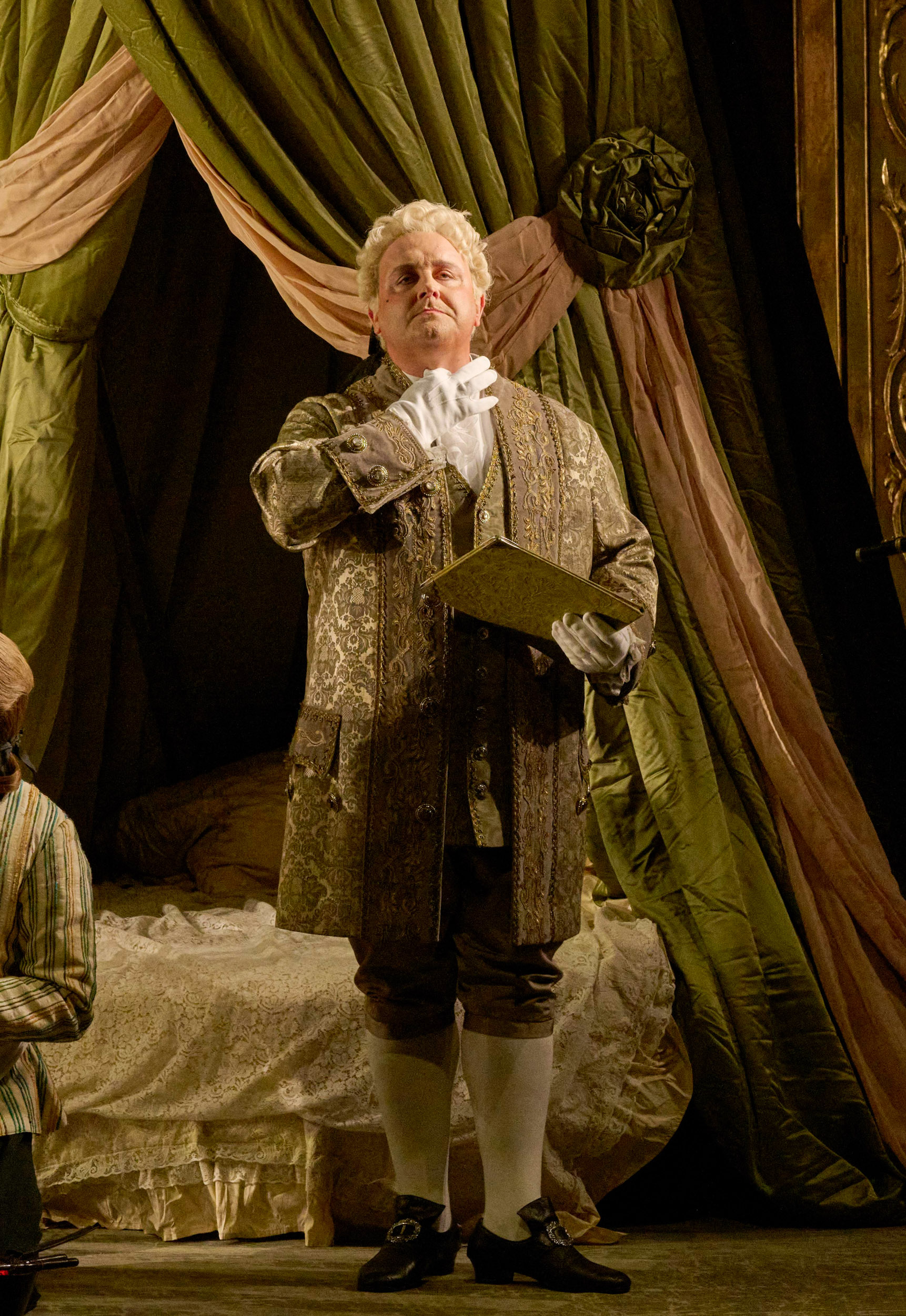
Der Rosenkavalier © Wiener Staatsoper / Michael Pöhn
The freedom to move between different styles of repertoire has also changed over time. By the early twentieth century, much of the bel canto tradition had disappeared from the stage, leaving singers with a far narrower range of works to explore. “I think all of them would have done bel canto had they had the chance,” he says.
The same flexibility can be seen in earlier generations of singers. Spyres points to the first Tristan, Ludwig Schnorr von Carolsfeld, who was simultaneously preparing Don Ottavio in Don Giovanni. “No one even thinks that way nowadays, but that was the precedent,” he notes.
Spyres therefore sees his own career less as a break with tradition than as the product of a fortunate moment in operatic history. By the time he entered the profession, much of that forgotten repertoire had returned to the stage, making it possible once again to move more freely between styles. “I was just lucky,” he reflects, “to be raised when I was.”
That interest in forgotten traditions continues to shape Spyres’s work today. Recently, he collaborated with Romanian conductor Gabriel Bebeșelea and a period orchestra on what he describes as the first complete Verdi album recorded at A=432 Hz, a pitch standard favoured by the composer himself.
One of the most important aspects of the project was to demonstrate that in Verdi’s time there was barely any difference between the Verdi baritone and the tenor. “If you were a little higher, you would go more towards tenor. If you were a little lower, you would go toward baritone,” Spyres explains. Discussing the physical effect of lower pitch standards, he notes that 432 Hz allows for more natural overtones while placing less strain on the voice: “In 432, there is not the same kind of physical feeling and sensation that would make you need to switch over into a different technique as today.”
For Spyres, projects like this allow people to understand why opera is the way it is today and what has been forgotten along the way.
Understanding how singers of the past approached their art was one thing; finding his own artistic identity proved far more difficult. “I’m really good at imitation,” Spyres says with a laugh. It allowed him to absorb an enormous amount from the singers he admired, but it also delayed discovering who he was as an artist. “That’s why it took me years to find my own voice.”
Over time, he learned to borrow qualities rather than entire voices, taking inspiration from phrasing, diction, colour, and technique. Only then did he begin to develop a sound and artistic personality that felt genuinely his own. Looking back, Spyres sees that long process as central to the career that followed. “I spent twenty years building the technique that I have now,” he says. “Most people just don’t have a fifteen-year incubation period of going here, then there, then somewhere else.”
At the heart of that long journey, shaped by curiosity, historical research, and a willingness to challenge accepted boundaries, lies a broader belief about the purpose of art itself. “The whole point of an artist,” he says, “is to see borders and find a way around them.”
Yet this pursuit of new territory demands an equal measure of self-knowledge. “You need to respect the boundaries of your own instrument,” he explains, “but always realise that you can make your bubble bigger.”
For Spyres, that is where the magic lies.
That philosophy has shaped a career of unusual breadth. By the time of our meeting, Spyres had just reached the milestone of his hundredth operatic role, appearing as the Italian Singer in Strauss’s Der Rosenkavalier. Yet even after a hundred roles, choosing favourites is no simple task.
One role returns almost immediately. “Honestly, Hoffmann is probably one of my favourite roles,” he says. Through Hoffmann, he inhabits several different personalities within a single work while exploring themes that resonate deeply with his own artistic outlook. “It’s all about the magic of art and storytelling,” he explains, “and the beauty and the elevation of what art is supposed to be for humankind.”
Another role that occupies a special place in his heart is Candide. Spyres is drawn to the character’s journey from innocence to experience, from youthful idealism to a more grounded understanding of life. When he and his wife exchanged wedding vows, they chose lines from Candide: “We’re neither pure nor wise nor good, but we’ll do the best we can. We’ll build our house and chop our wood and make our garden grow.” Recalling the moment still visibly moves him. The words reflect a philosophy that extends far beyond the stage. “Opera’s just grown with me,” he says.

Die Walkuere © Wiener Staatsoper / Michael Pöhn
Even after a hundred roles, he speaks less about achievements than about new possibilities still waiting to be explored. One of those is Verdi’s Otello, a role he has yet to perform but already speaks about with unmistakable enthusiasm. “I can’t wait to do it,” he says.
His interest with the character is also shaped by his experience with Rossini’s Otello, a role he has performed and speaks about with affection. He describes it as a remarkable work, but one shaped by the conventions of its time and offering a more restrained dramatic and psychological development compared with Verdi’s later version of the story.
“That’s why I’m excited to really go into that character,” he says. “I find him fascinating.” Then he pauses and laughs. As much as he is looking forward to Otello, another character in the opera attracts him even more. “I find Iago even better,” he admits. “He’s so much more fun.”
Long before he became an opera singer, Spyres was already accustomed to stepping into different roles. His mother was a playwright and actress, and the Spyres family was often involved in performances at community gatherings. “I’ve been in front of people since I could talk,” he recalls. “Becoming another person is very natural.”
That instinct continues to shape the way he approaches characters today. Human beings are complex and never one-dimensional, and he believes operatic characters should be approached with the same level of complexity.
Nemorino provides a revealing example. Too often, Spyres argues, the character is reduced to a village fool simply because he cannot read. He rejects that interpretation entirely. He recalls an uncle with severe dyslexia who worked in highly complex technical fields connected with NASA long before learning to read fluently. Intelligence, he argues, cannot be measured so simply. “Nemorino might be naïve,” he says, “but he’s not stupid.”
Ultimately, characters become convincing only when their contradictions are acknowledged. Rather than imposing a role from the outside, Spyres searches for the part of the person that already exists within him. “None of them are outside of me,” he explains. “They’re all part of me. I just find that aspect and put it into the character.”
Spyres describes his approach to character-building through the vivid image of a puppeteer and a puppet. During preparation, the singer must be the puppeteer: analysing the role and shaping interpretation. Once the performance begins, however, the balance shifts. “On stage I go into that character and I’m the puppet.” This philosophy also helps explain his calmness as a performer. Having spent his life in front of audiences, he feels remarkably comfortable on stage. What unsettles him is not the presence of thousands of people, but something far more technical: “The only time I get nervous is when I have to memorise something and then recite it perfectly.”
When asked whether he had ever lost himself in a role, Spyres recalls an incident from early in his career. Performing a mad king, he became so absorbed in the character that he briefly lost his bearings on stage. “People thought it was great acting,” he says with a laugh. “I actually fell down.”
Yet experiences like that have also taught him the importance of maintaining perspective. “I think some people get lost in roles because they’re searching for something inside themselves,” he adds. “I’ve done my share of soul-searching in life.” Even so, the constant movement between identities can be disorienting. On a busy day he might spend six hours inhabiting Siegfried before returning to himself. After weeks on the road, he admits, it can sometimes take a moment to reconnect with the rhythms of his own life.
The laugh that follows does not entirely disguise how strange that experience can be. “I still feel like a floating entity at times,” he says. “You question every day: what am I, what is the story I’m telling myself? And it’s very difficult if you don’t have a strong grip on your own psyche.”
Beyond creating a character, Spyres believes the ultimate purpose of performance is communication. However carefully a role is prepared, it only comes fully alive in the encounter between artist and audience. He describes the process almost physically: a sound leaves the singer, travels through the air, reaches the listener, and in that exchange, something is created that neither performer nor audience could produce alone.
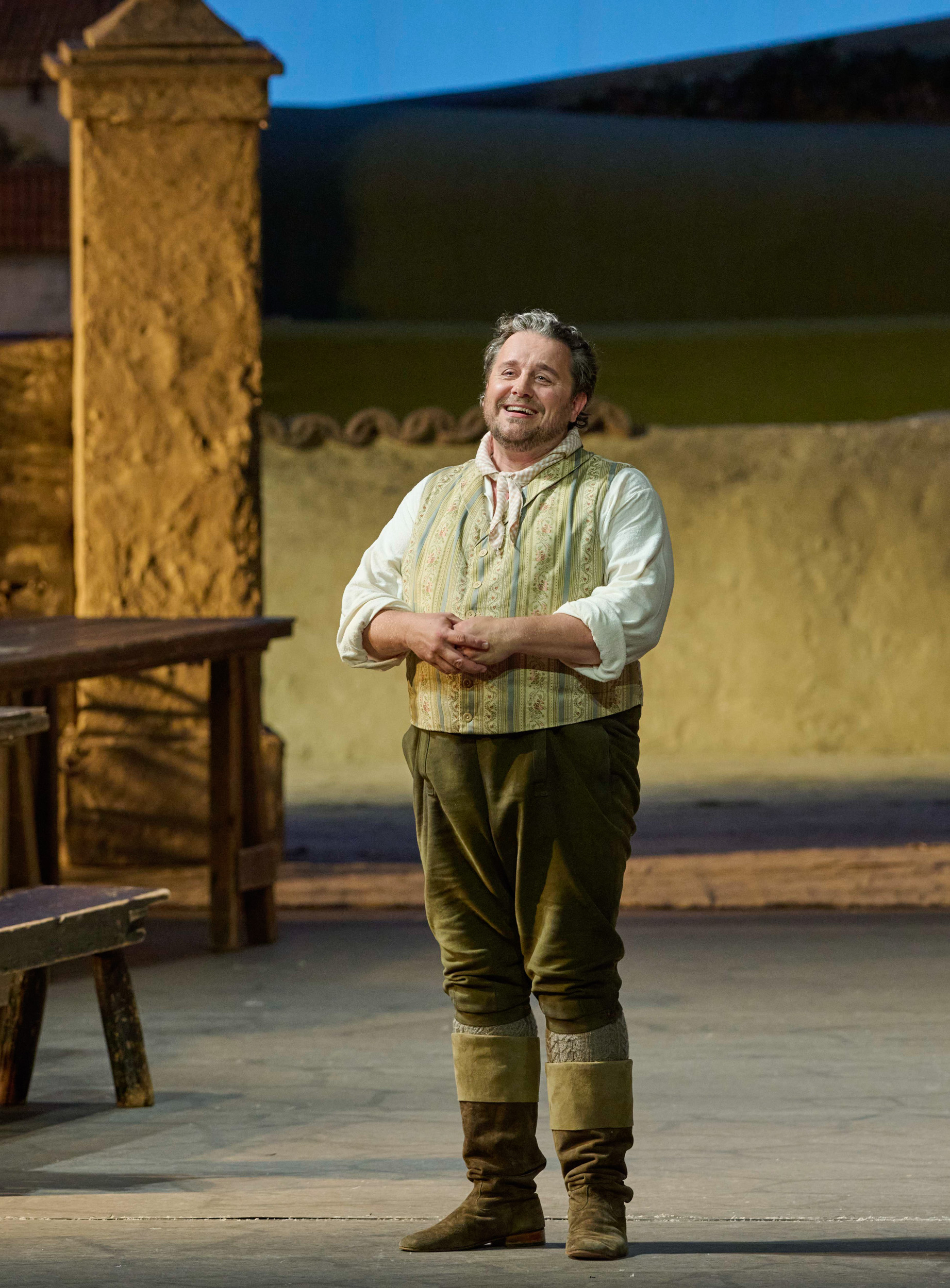
L’elisier d’amore© Wiener Staatsoper / Michael Pöhn
It is one reason he has become increasingly skeptical of the pursuit of technical perfection. He compares singers to professional athletes. Michael Jordan, widely regarded as the greatest basketball player of all time, missed far more shots than he made. Yet nobody remembers him for the misses. “He’s still considered a genius because of the totality of what he achieved,” Spyres observes. For singers, he believes, the goal cannot be the avoidance of every mistake. What matters is the willingness to remain present, spontaneous, and fully engaged in the act of communication, even if that means accepting a degree of imperfection along the way.
Spyres also recalls a personal experience that reinforced this belief. More than a decade ago, after a performance he considered nearly flawless, his wife offered a different assessment. “It was kind of boring, to be honest.” For all its technical polish, he realised, the performance lacked the genuine connection with the audience that gives live theatre its vitality.
Questions of communication inevitably led us to the subject of stage direction and the often polarising debate surrounding Regietheater. Spyres rejects a simple division between traditional and modern productions. Reinterpretation can open new perspectives and reveal aspects of a work that might otherwise remain hidden, but novelty alone is not enough.
What concerns him more is the tendency to treat operas as material to be endlessly deconstructed and rearranged according to an external concept. He links part of this tendency to the influence of deconstructionism and postmodernism in the arts during the second half of the twentieth century. While he acknowledges that such approaches can be useful in questioning structures, he believes the difficulty lies in putting them back together again. Operas, he argues, already carry an internal dramatic and musical logic of their own.

Tristan and Isolde © Karen Almond / Met Opera
When that logic is ignored, problems arise in practice. He recalls one production in which scenes were completely reordered to serve a directorial concept, disrupting both the narrative and the performers’ work.
He admits that his willingness to challenge certain productions has occasionally put him at odds with directors. “I’ve probably been blacklisted by some directors,” he says. He has also turned down productions he did not believe in. Ultimately, what matters for Spyres is whether a production deepens the story already contained within the score or merely draws attention to the concept itself.
When it comes to working with conductors, Spyres draws on his family background and experience with different instruments, which gives him a broad understanding of both conductor and orchestra. He approaches rehearsals not only through his own vocal line but through the architecture of the entire score, and enjoys discussing orchestration, structure, and dramatic pacing. This perspective shapes a way of working that feels natural and immediate. He often jokes that when he is on stage, he becomes so absorbed in the music that he briefly forgets he is supposed to be singing rather than conducting.
That awareness becomes particularly important in large-scale productions. Recalling Tristan, he remembers moments when he was positioned so far from the conductor that hearing the orchestra became very challenging. At times, separated by some thirty metres from the pit, he had to anticipate the beat rather than react to it, mentally calculating the delay created by distance and acoustics.
Talk of conductors and performance soon led to the subject of stage partners. For Spyres, the ideal colleague is someone capable of genuine interaction, where artists listen and respond to one another in real time rather than simply waiting for cues. He particularly values performers with a strong sense of theatre and the flexibility to adapt.
Partnership for him extends backstage. As he is relaxed and open in rehearsal and performance situations, he is always ready to support colleagues in the wings before going on stage. For him, creating an atmosphere of trust and ease is an important part of the shared process of performance.

Les Contes d’Hoffmann, Opéra-Comique © Stefan Brion
Same spirit of collaboration ultimately points to something larger. Spyres describes opera as a true “meta-art” form, where music, poetry, theatre, visual art, dance, architecture, and storytelling converge within a single performance. “All the tentacles of the octopus are the arts,” he says, “and the head of it is opera.” What emerges is a single artistic form built on the coordination of hundreds of people working toward the same purpose. Its power lies not only in what it expresses, but in the extraordinary human collaboration required to bring it to life. “That’s why I love what we do so much,” he says.
For all his international success, Spyres remains remarkably detached from the idea of celebrity. “What I truly love as a singer and a performer is the act of being a teacher, of sharing knowledge and connecting,” he says. “It is never about ‘look at me’ or feeding a hungry ego.”
That perspective is rooted in his upbringing. Having grown up watching his parents dedicate their lives not only to music education but also to helping those around them, he witnessed the lasting impact they had on generations in the Ozarks. Their influence extended far beyond the classroom, shaping lives and offering support to those who often had nowhere else to turn. That example continues to shape his understanding of what it means to be an artist.
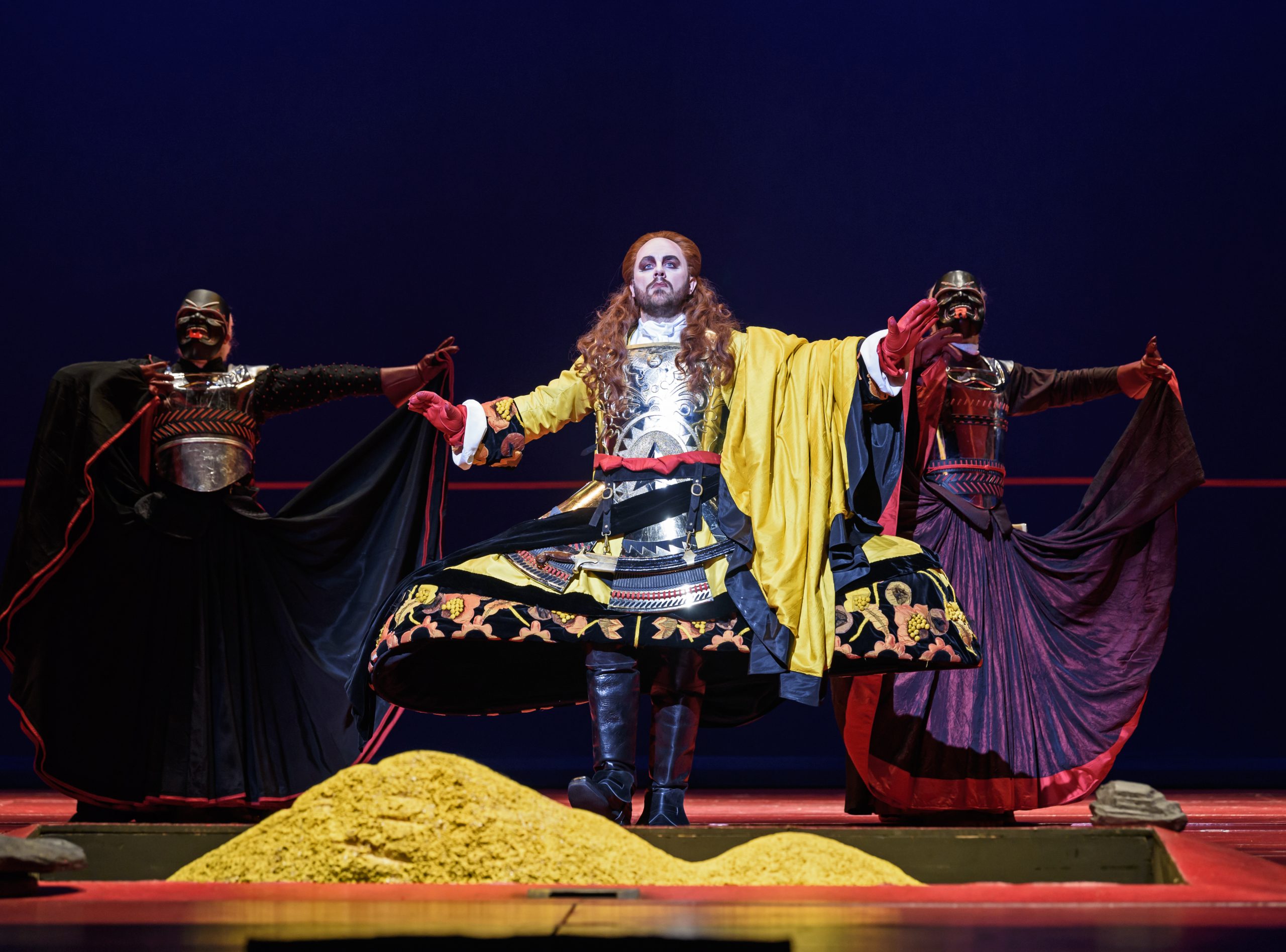
Mitridate © ROH / Bill Cooper
He laughs when recalling how little operatic distinctions matter back home. Mentioning that he had been awarded one of France’s highest cultural honours to friends in Missouri, he was met with mild curiosity before the conversation quickly turned to a far more practical subject: what kind of beer he preferred. The story delights him because it keeps everything in perspective. In the end, beyond titles and accolades, he sees himself simply as someone fortunate enough to spend his life doing what he loves. “I get paid for making people happy,” he says. “There’s no better profession in the world.”
As our conversation draws to a close, what stays with me is the vivid impression of Michael Spyres as an artist in constant motion, driven by the same curiosity that first ignited his journey.
After all, that is where the magic lies.
Catrine N.Andro
Hotel Chateau Eniseli Bagrationi
Cristina Bersanelli