
ZÜRICH: La clemenza di Tito – Wolfgang Amadeus Mozart, 26 April 2026
La clemenza di Tito
Wolfgang Amadeus Mozart
Opera in two acts
Libretto by Caterino Mazzolà after Pietro Metastasio
Premiere: 6 September 1791, Estates Theatre, Prague
Musical Director: Marc Minkowski
Production: Damiano Michieletto
Cast
- Tito Vespasiano: Pene Pati
- Vitellia: Margaux Poguet
- Servilia: Yewon Han
- Sesto: Lea Desandre
- Annio: Siena Licht Miller
- Publio: Andrew Moore
Set Design: Paolo Fantin
Costumes: Klaus Bruns
Lighting Design: Alessandro Carletti
Chorus Master: Ernst Raffelsberger
Dramaturgy: Kathrin Brunner
Continuo Hammerklavier: Enrico Maria Cacciari
Solo Clarinet / Basset Horn: Robert Pickup
Chor der Oper Zürich
Orchestra La Scintilla
Emperor Titus is remembered for his restraint and clemency, yet history whispers of a single unnamed regret he carried to his grave.
In his new production of La clemenza di Tito at the Opernhaus Zürich, Damiano Michieletto seems to build the drama around that silence. Can clemency, the very pillar of Titus’s power, also become his undoing? What if mercy, extended too far, leaves something fundamentally unresolved?
This tension underpins Michieletto’s staging, which abandons historical distance in favour of a contemporary landscape marked by restraint and latent tension. At the centre of the drama lies the triangle between Tito, Sesto, and Vitellia: a ruler committed to mercy, a friend divided between loyalty and destructive devotion, and a woman whose desires help propel the opera toward catastrophe. The drama turns not on whether Tito forgives, but on the consequences of that forgiveness.
The Orchestra La Scintilla under Marc Minkowski proves central to the production’s impact from the very first bars. With the orchestra placed in a raised pit, music gains vivid colour and clarity. Particularly effective is the close dialogue between pit and stage. Minkowski leads with brisk, tightly controlled tempi, sustaining a musical flow balanced between tension and restraint. Special mention must go to Enrico Maria Cacciari at the fortepiano and Robert Pickup on clarinet and basset horn for the distinctive intimacy they bring to the performance.
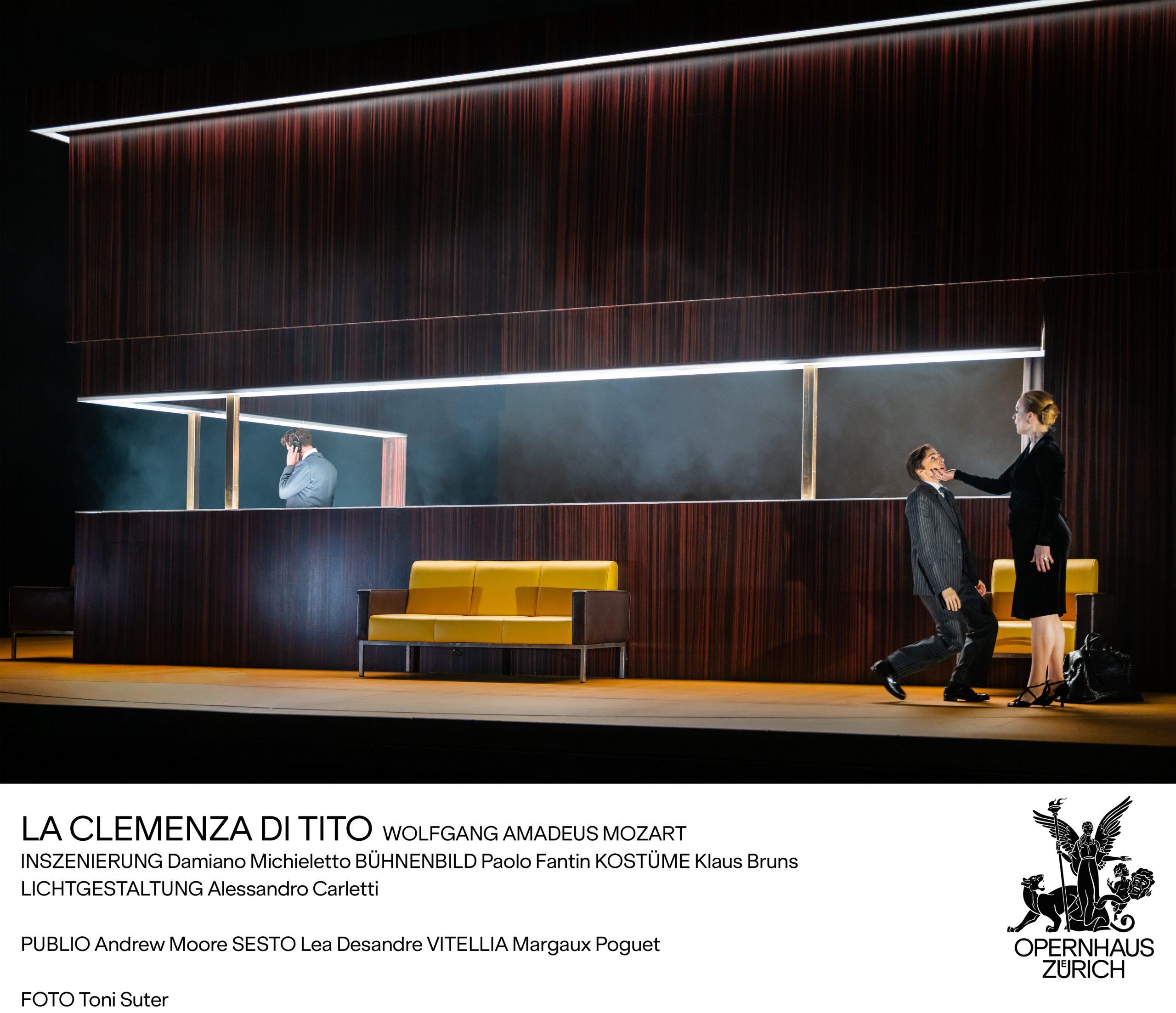
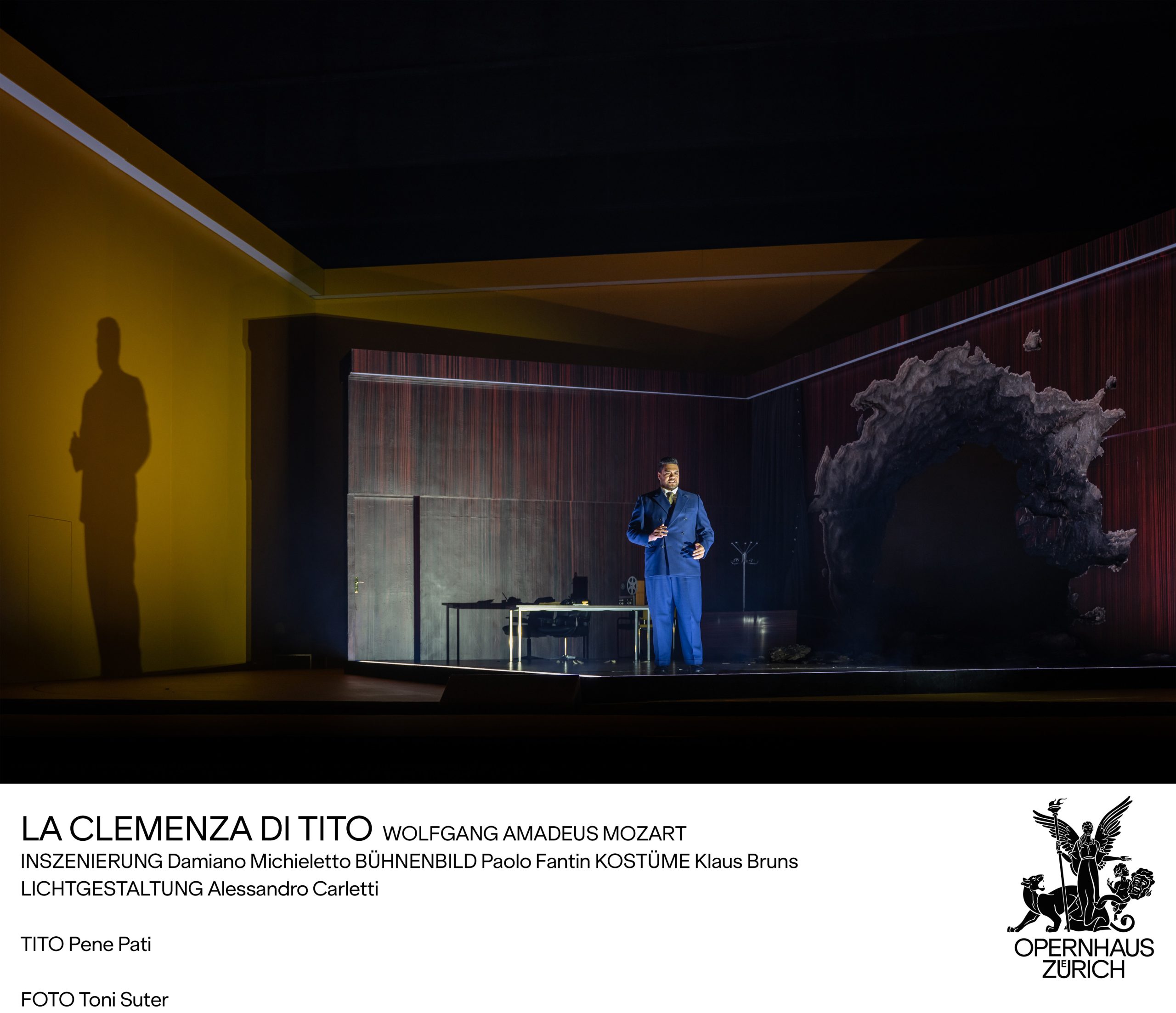
Paolo Fantin’s set proves consistently effective in serving Michieletto’s intentions. The sleek architectural environment, dominated by wood surfaces and saturated yellow walls, gives the stage the appearance of a polished institutional façade. At centre stands a large rotating L-shaped structure that continuously transforms throughout the evening, shifting from Tito’s formal office into corridors and interiors where inner fractures emerge. While one might occasionally wish for less rotation, the turning stage pulls the audience insistently into the vertiginous drama. Alessandro Carletti’s controlled lighting follows the drama with great sensitivity, intensifying in Act II as shadows spread across the fractured walls, creating ghost-like doubles that reflect the characters’ inner turmoil. Klaus Bruns’s refined mid-20th century inspired costumes blend seamlessly into this carefully constructed visual world.
Important to Michieletto’s interpretation is the surveillance system operated by Publio. During the overture, he is already seen hiding listening devices throughout the furniture. Even Sesto and Vitellia’s earliest exchanges unfold under watchful eyes, suggesting a system already aware of the conspiracy.
The almost storm-like entrance of Vitellia, a Roman noblewoman whose ambition and feelings for Tito have turned into bitterness after his decision to marry another woman, immediately establishes a figure of dangerous determination and power. Margaux Poguet brings considerable dramatic force to the role, combining vocal power with a constant sense of volatility. Particularly effective is Deh, se piacer mi vuoi, where manipulation and urgency seem carried directly through the vocal line. At moments, some of the highest notes acquire a slightly harsher edge, yet it also contributes to the impression of a woman constantly operating at extremes.
Opposite her stands Sesto, portrayed by Lea Desandre with strong psychological depth. Fragile, deeply insecure, and entirely under Vitellia’s manipulative dominance, he nevertheless finds the resolve to carry out her order to assassinate his friend and benefactor. The clash of devotion to Vitellia and loyalty to Tito gives the character much of his tragic tension.
Desandre captures Sesto’s contradictions with extraordinary nuance. In Parto, parto, the agile coloratura and dazzling high notes unfold with assured control, while the warmth of the voice brings a rich expressive palette of colour. The performance consistently balances lyrical sensitivity with dramatic urgency, allowing Sesto’s devotion, confusion, and inner conflict to emerge with coherence.
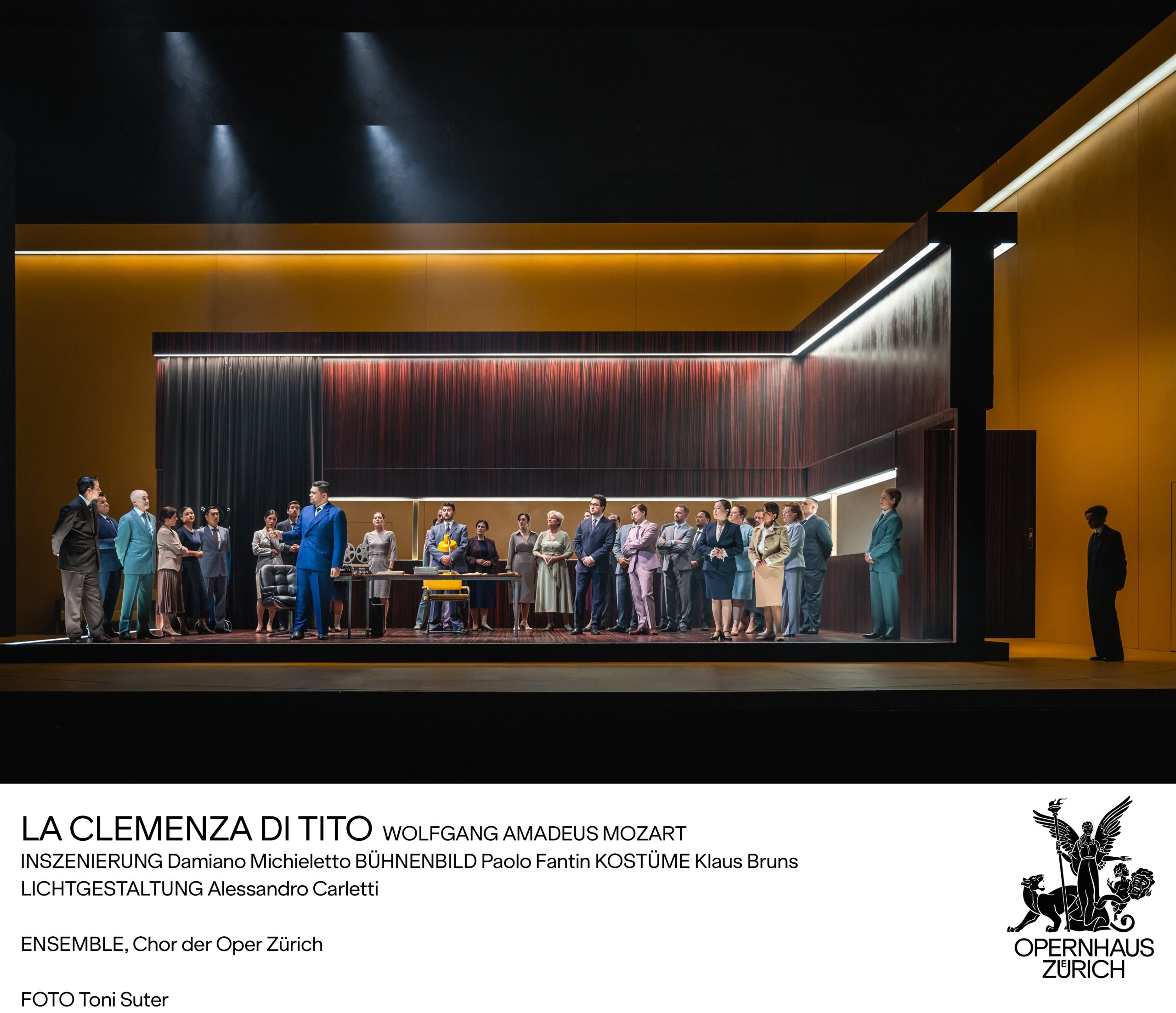
The first major rotation of the set fully reveals Tito’s office, which also serves as the senate chamber. Ballots are placed into a Roman-style urn under Publio’s coordination, probably the only direct references to the opera’s ancient origins.
Tito enters at this moment, dressed in a blue suit that subtly separates him from the surroundings. He appears not as a distant emperor but as a restrained and deeply compassionate figure. Pene Pati portrays Tito with lyrical warmth and sincerity. His bright upper register, effortless high notes, and technical agility bring brilliance and flexibility to the role, alongside an unmistakable sense of the character’s humanity.
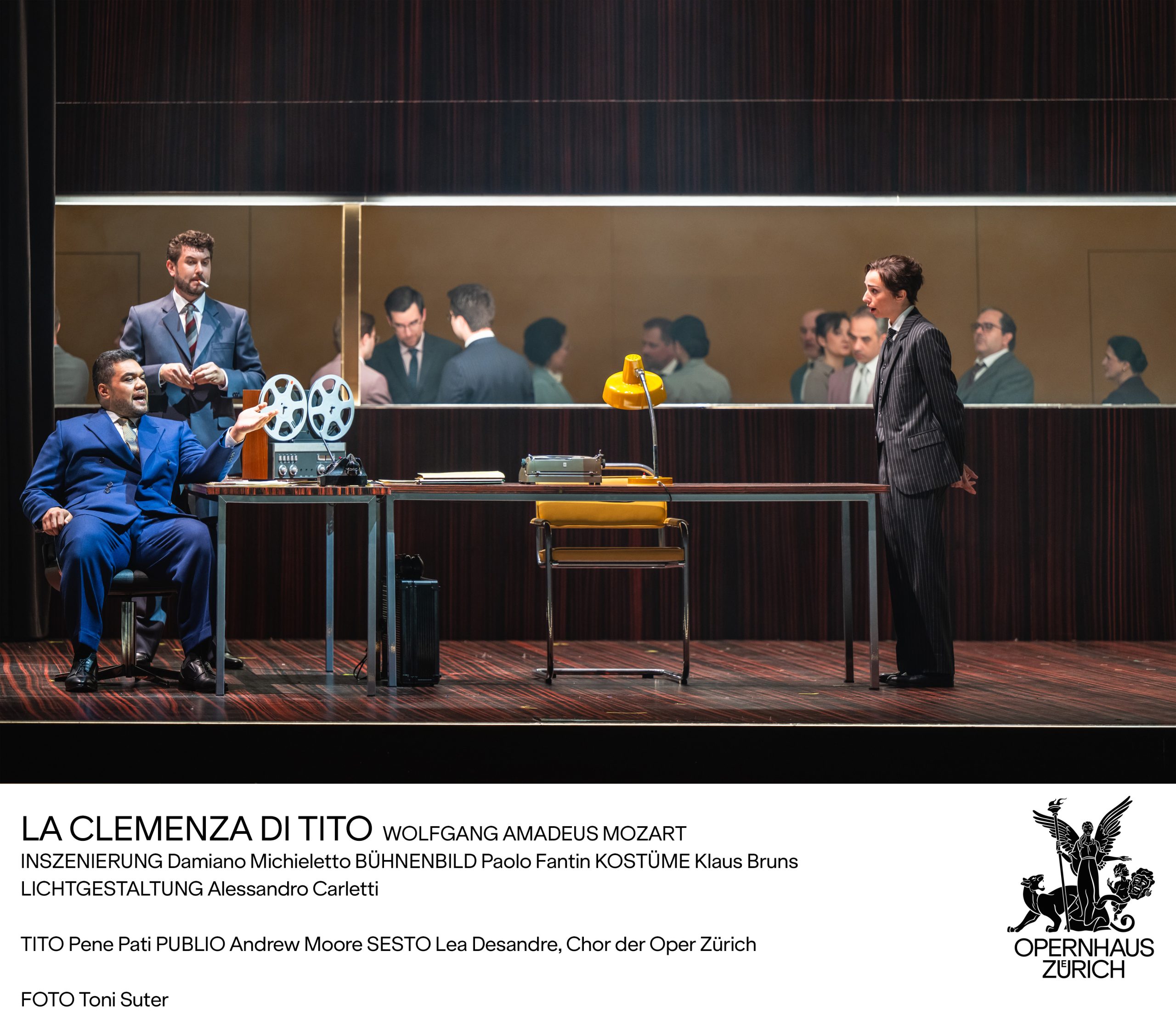
At the same time, the first hints of Publio’s attitude toward Tito begin to emerge, as though the emperor’s kindness is viewed as political weakness. Seated beside Tito in a yellow armchair, Publio remains in constant proximity to the emperor, while the reel-to-reel recorder on Tito’s desk keeps surveillance visible.
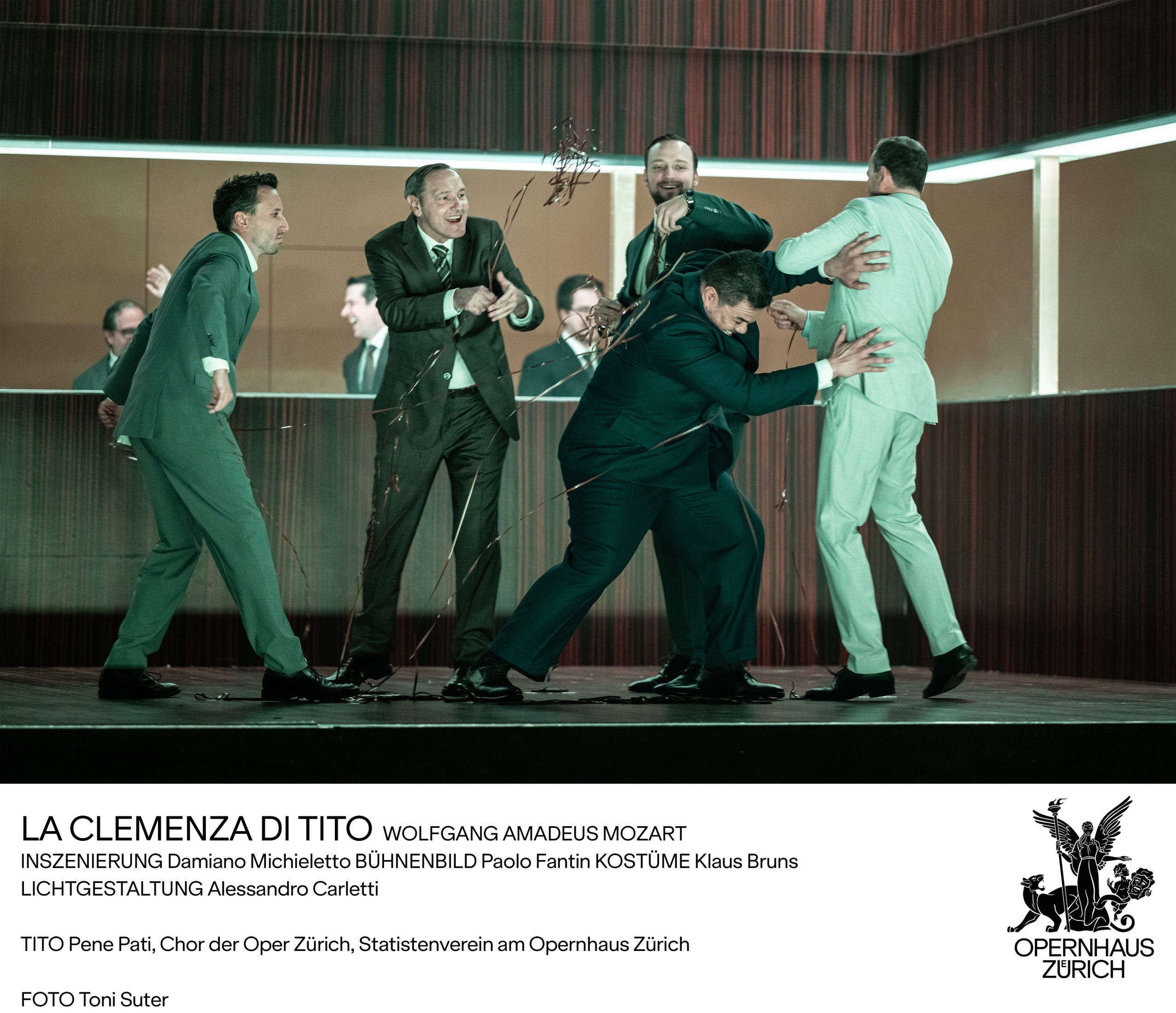
During Tito’s aria Ah, se fosse intorno al trono, as he reflects on the loneliness of power and the desire for loyalty, suited men enter the office through wall openings and mock him while reels of recording tape are thrown over him, visually entangling him within the machinery surrounding him.
Against this dark environment, Servilia introduces a rare sense of sincerity into the production. Dressed in a light gown with delicate blue flowers, she remains one of the few characters willing to stand openly before Tito. Her refusal to marry Tito out of loyalty to Annio, together with the clarity with which she later confronts Vitellia about the scale of Sesto’s sacrifice, gives the character quiet moral strength within the opera. Yewon Han brings a clear and elegant vocal line that provides a much-needed tonal contrast to the surrounding atmosphere, grounding Servilia’s sincerity in a performance of calm inner strength.
Alongside her, Siena Licht Miller brings warmth and quiet assurance to Annio, shaping him as a figure of loyalty and fairness. Singing with a velvety voice and grounded stage presence, she provides steadiness beside Sesto’s instability. Miller’s dramatic engagement is equally convincing, whether in Annio’s distress upon learning that Tito intends to marry Servilia, in the tenderness of the duets with Servilia, or in the growing anxiety surrounding Sesto’s betrayal.
Publio gradually emerges as one of the evening’s most unsettling figures. His awareness of the conspiracy becomes unmistakable in the moment when, visible through openings in the wall, he prepares Tito’s double just as Vitellia gives Sesto the final order and hands him the explosives.
The confrontation between Vitellia and Sesto at the end of Act I turns the stage into a space of inner turmoil. Lea Desandre portrays Sesto with persuasive conviction, allowing his hesitation to kill a friend and his uncontrollable obsession with Vitellia to collide fully in both the singing and physical performance.
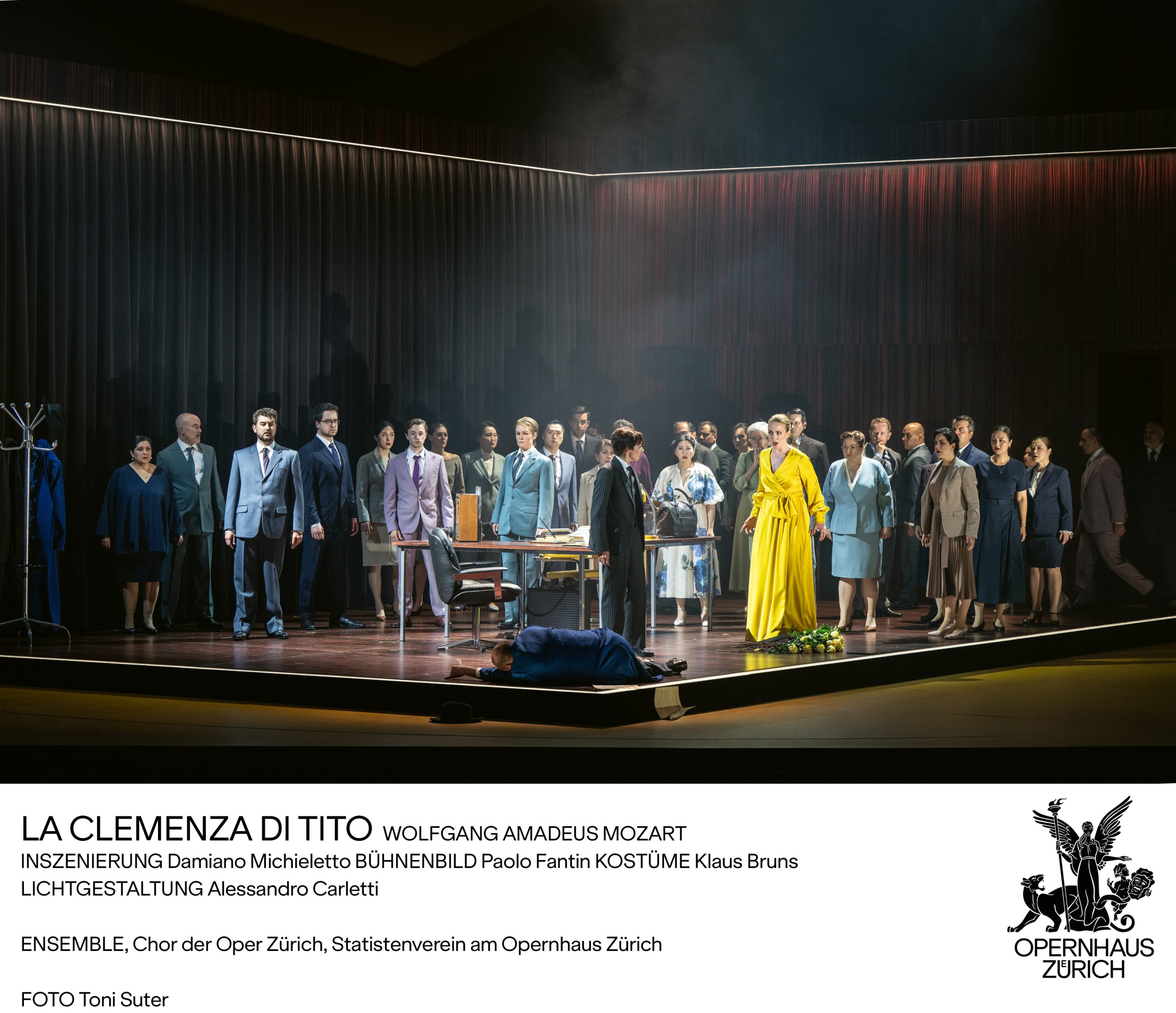
The action unfolds once again in Tito’s office, where the emperor sits almost motionless, seemingly awaiting his fate while Sesto carries out Vitellia’s command. In the background, Vitellia, now dressed in a vivid yellow evening gown, receives yellow flowers together with the news that she is to become the future empress. At the very instant of triumph, her world begins to collapse, and Margaux Poguet reveals the character simultaneously exultant and ruined.
The act closes with a cinematic image: the chorus, Tito lies on the floor, and Vitellia, surrounded by fallen flowers, becomes the visual focus of the tragedy. Instead of any grand explosion, destruction is reduced to the blinking detonator fixed to the wall before the stage falls into darkness.
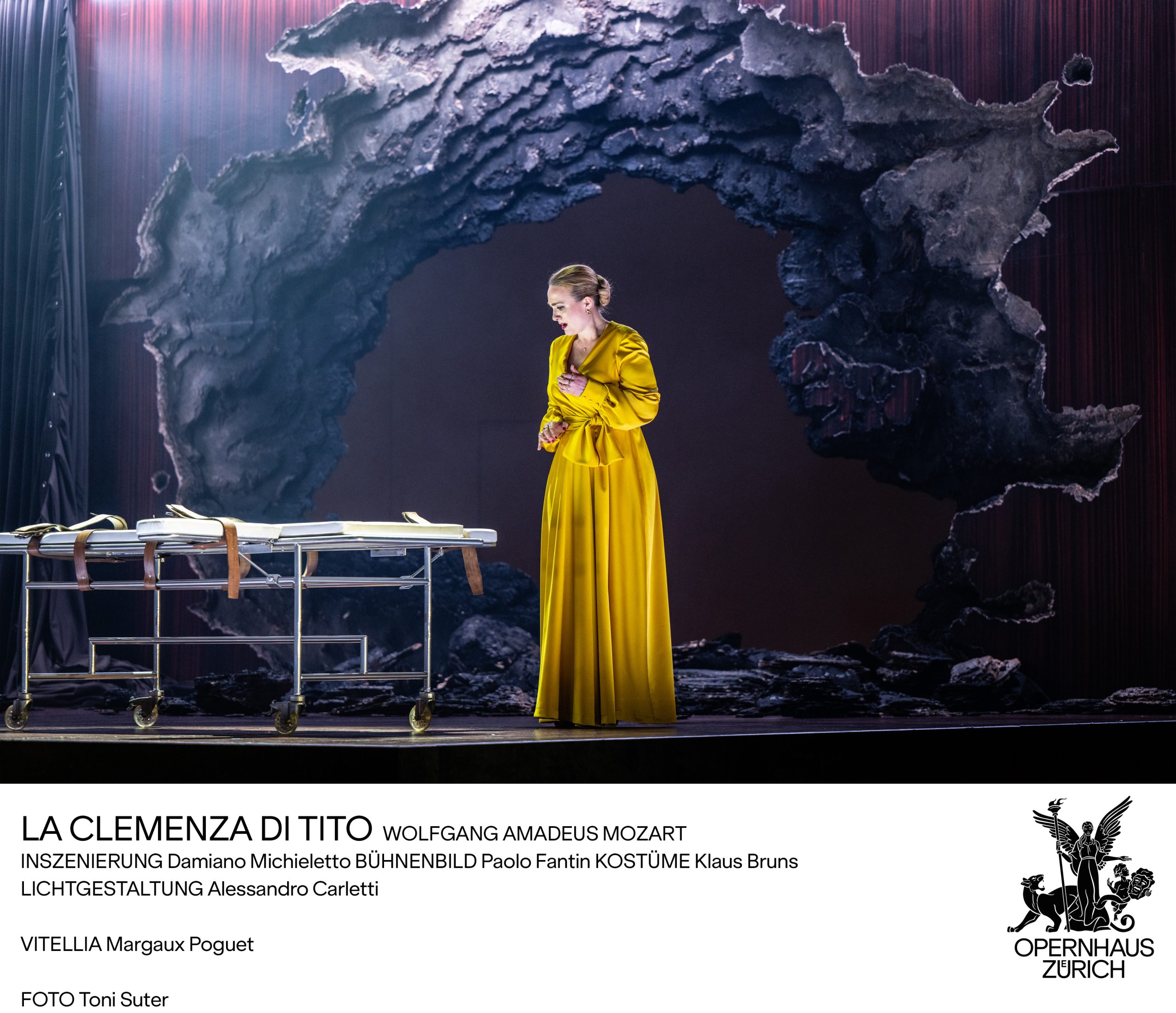
Act II opens onto a radically transformed stage. Tito’s polished office has been violently torn apart by a massive, blackened rupture dominating the set. The ruins remain throughout the act, serving as a permanent reminder of the explosion’s consequences.
Tito survives, yet when he attempts to reconnect with those around him, he is met instead with distance and coldness, while Publio now appears openly tense and judgmental, especially as Tito struggles to accept Sesto’s betrayal. The chorus surrounds the scene with singing marked by growing severity and restraint. One of the production’s most haunting images shows Tito standing before a pile of bodies near the ruptured blast opening, blood visible, while one figure moves toward him. The scene feels nearly hallucinatory, as though the victims themselves embody the human cost of his mercy.
The arrest of Sesto by the modern security squad becomes one of the production’s clearest displays of state power. Their harsh contemporary uniforms cut violently through the refined pastel world established earlier.
Act II brings the musical and emotional tensions into sharper focus. Pene Pati gives Tito deep vulnerability, portraying a ruler torn between friendship and responsibility. His interpretation of Se all’impero, amici Dei becomes one of the production’s highlights, combining technical assurance with deep dramatic weight.
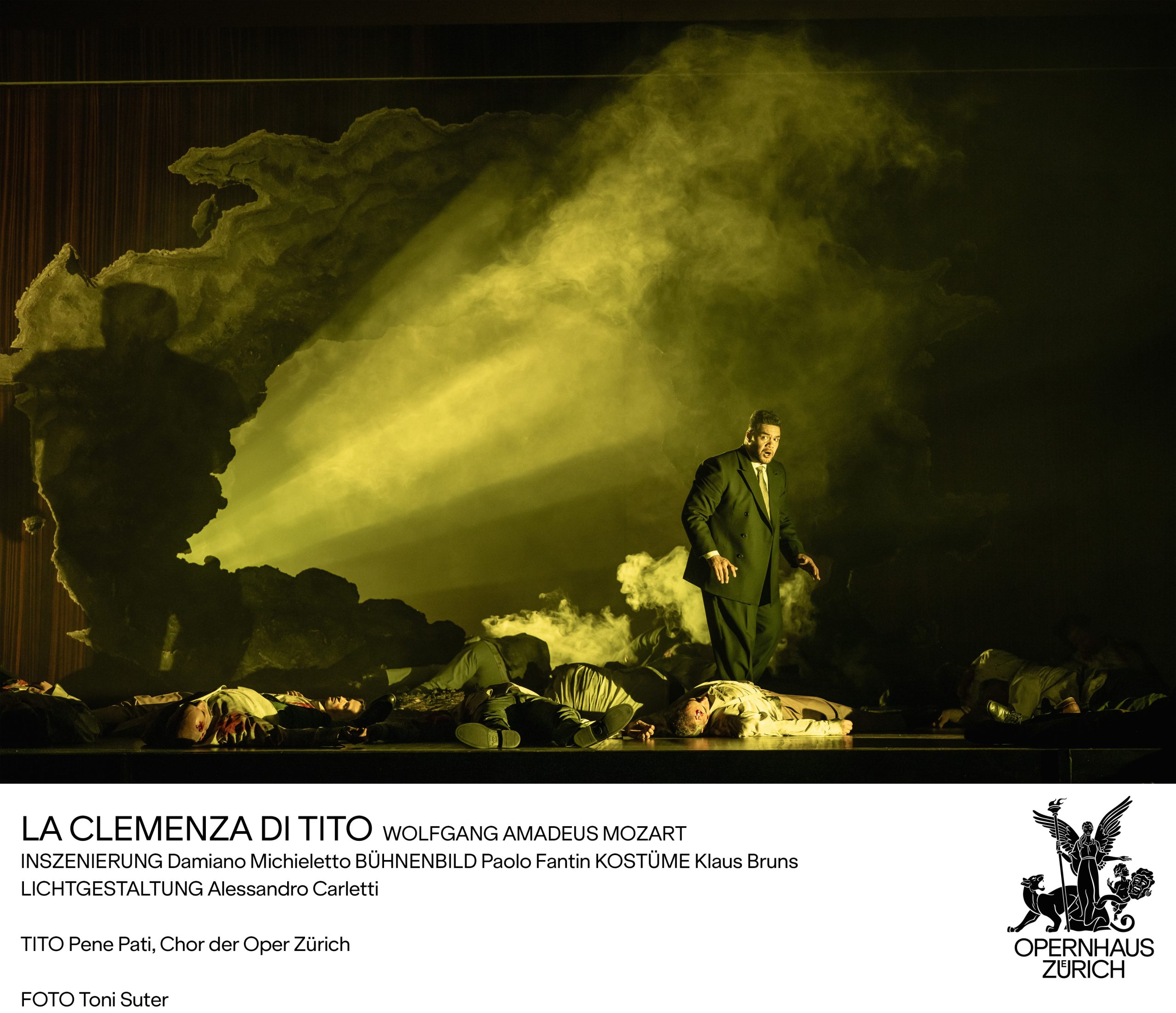
Lea Desandre, meanwhile, sustains Sesto’s collapse with strong intensity. Her scenes with Tito acquire intense depth, reinforced by the staging that isolates her on the yellow chair at the edge of the stage. In Deh, per questo istante solo, vulnerability and despair emerge with devastating immediacy, the beauty of the vocal line constantly colored by exhaustion and guilt.
Vitellia’s Non più di fiori reveals her final fracture. Margaux Poguet uncovers the character’s vulnerability beneath the authority, exposing a woman overwhelmed by the consequences of her own desires.
The production then shifts to the court scene. Rows of chairs and a stark execution table create a vision closer to a modern tribunal than an imperial ceremony, while figures in white medical gowns make it clear that the sentence will be carried out through lethal injection. Positioned among the audience, the chorus brings powerful vocal presence and mounting tension to the scene.
Vitellia remains on stage, standing between the execution bed and the giant rupture in the wall, destruction behind her, death directly before her.
The scene moves toward the execution, with all the principal figures present and Vitellia finally confessing her guilt openly. Tito repeats in despair: “How many traitors can there be?” A question gaining even greater weight by the end of the opera. And yet Tito chooses clemency. Sesto and Vitellia are pardoned.
However, Michieletto decisively departs from Mozart’s vision of reconciliation. By the final scenes, Andrew Moore’s Publio fully emerges as the production’s hidden centre of gravity. Moore combines a firmly projected, dark-toned voice with quiet authority and steadily increasing menace, shaping Publio into observer, manipulator, and ultimately enforcer of order. Publio appears convinced that power can survive only through control, and if the ruler himself can no longer sustain order, someone else will ultimately assume that responsibility.
The production ends with one final gesture: Publio hands Tito a glass of whisky injected with lethal substance intended for Sesto, revealing the ultimate cost of clemency to be Tito’s own death.
Rather than provoking debate over its altered ending, what ultimately matters in the production is the clarity and consistency of the idea guiding it from beginning to end. The evening unfolded as an intense psychological journey, moving steadily toward its final image. Michieletto follows one of the opera’s central questions to its darkest possible conclusion, leaving behind not the reassurance of reconciliation, but the unsettling sense that mercy, stretched too far, carries a cost for those who choose to uphold it.
Catrine N.Andro
Hotel Chateau Eniseli Bagrationi
Cristina Bersanelli