
BERN: Tosca – Giacomo Puccini, 20 October 2026
Tosca
Giacomo Puccini
Opera in three acts
Libretto by Luigi Illica and Giuseppe Giacosa, based on Victorien Sardou’s play La Tosca
Conductor: Carlo Goldstein
Stage Director & Set Designer: Raimund Orfeo Voigt
Costume Designer: Klaus Bruns
Lighting Designer: Bernhard Bieri
Dramaturgy: Rainer Karlitschek, Dominik Kilchmann
Chorus Director: Zsolt Czetner
Children’s Chorus Director: Audrey Tan
Cast
Floria Tosca: Olga Busuioc
Mario Cavaradossi: Joseph Dahdah
Baron Scarpia: Seth Carico
Cesare Angelotti: William Meinert
Spoletta: Fabio Dorizzi
Sacristan: Christian Valle
Sciarrone: Dario Lupi
Jailer: Iyad Dwaier
Shepherd: Artian Taipi
Berner Symphonieorchester
Chor der Bühnen Bern
Kinderchor der Bühnen Bern
Buehnenbern, 20 October 2026
Love, jealousy, obsession, political intrigue and tragedy, all unfolding over the course of just twenty-four hours: Giacomo Puccini’s Tosca has almost everything one could ask of a gripping film. It is precisely this cinematic potential that director and stage designer Raimund Orfeo Voigt explores in his production at Bühnen Bern, approaching the opera as a mid-century crime drama.
photo©Janosch Abel
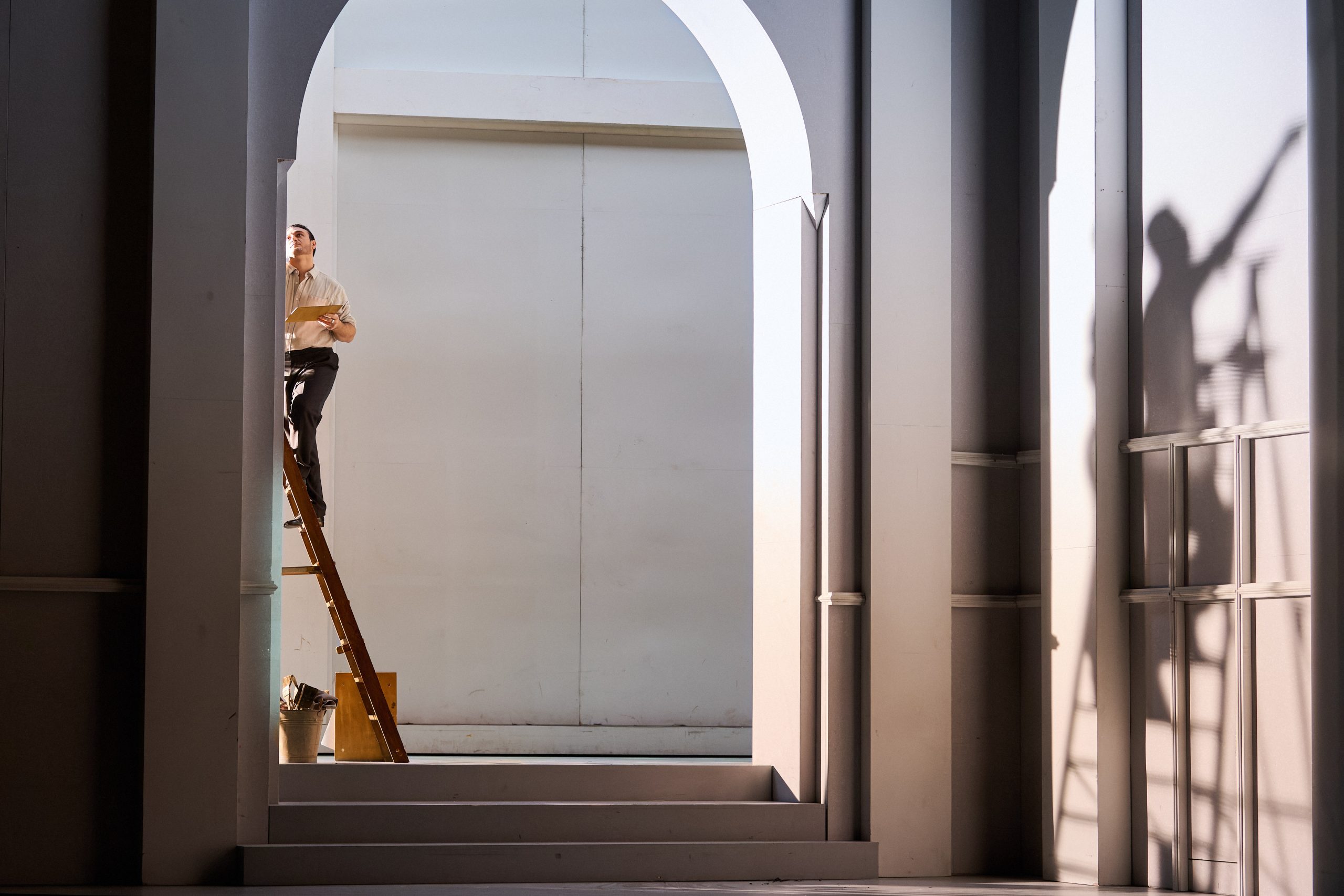
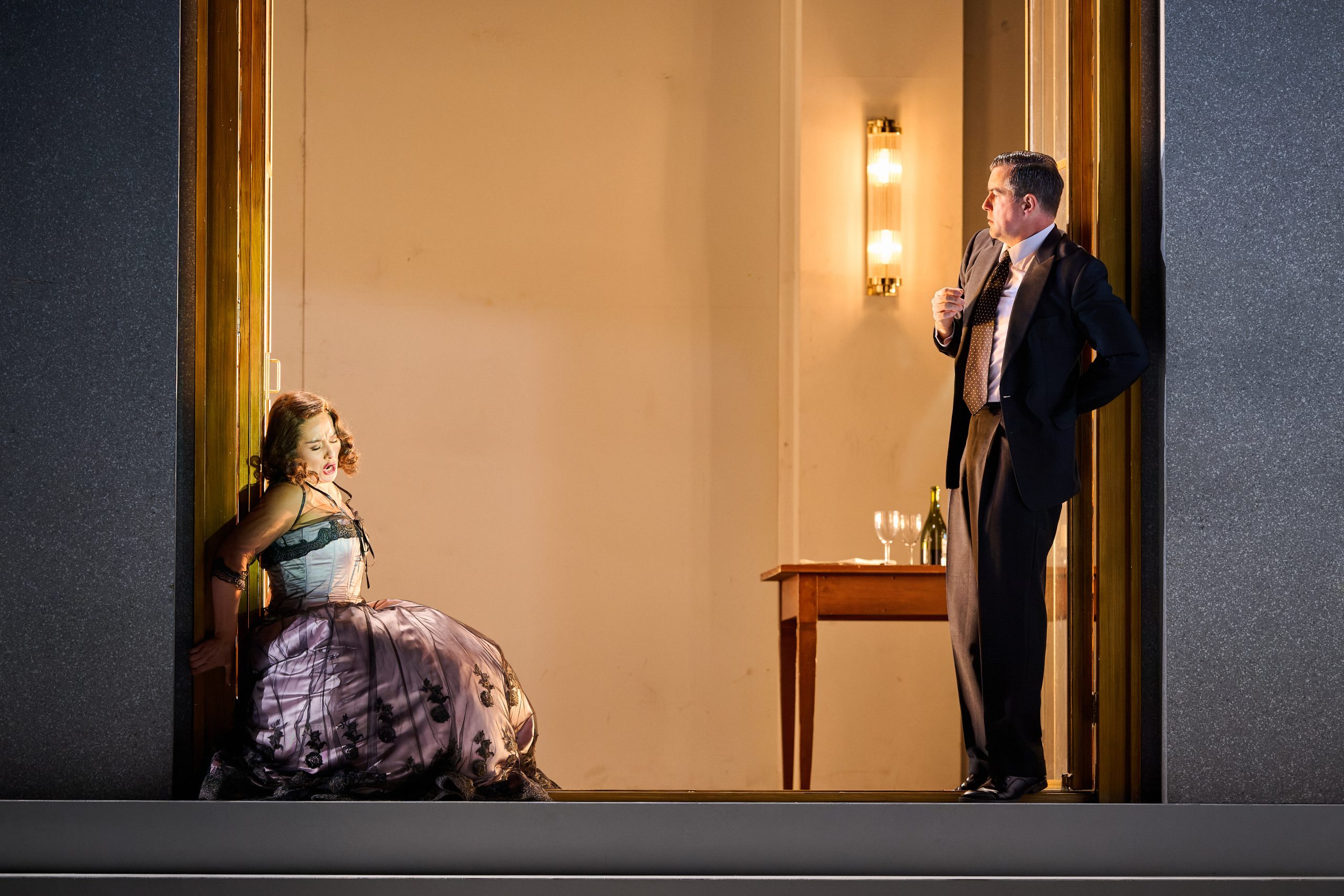
The staging works with framed perspectives, contrasts of light and shadow, and events that take place partly or entirely out of view. Voigt shifts our position as spectators, sometimes allowing us to witness events directly and at other moments leaving us to follow the drama through the characters’ reactions. Klaus Bruns’s costumes reinforce the restrained visual atmosphere, with a palette dominated by shades of grey and brown. Tosca stands apart, first in her colourful ensemble and later in a delicate lilac lace evening dress, becoming the visual centre of the production. Bernhard Bieri’s lighting adds depth to the bare settings, casting shadows across the walls and changing the atmosphere as the drama progresses.
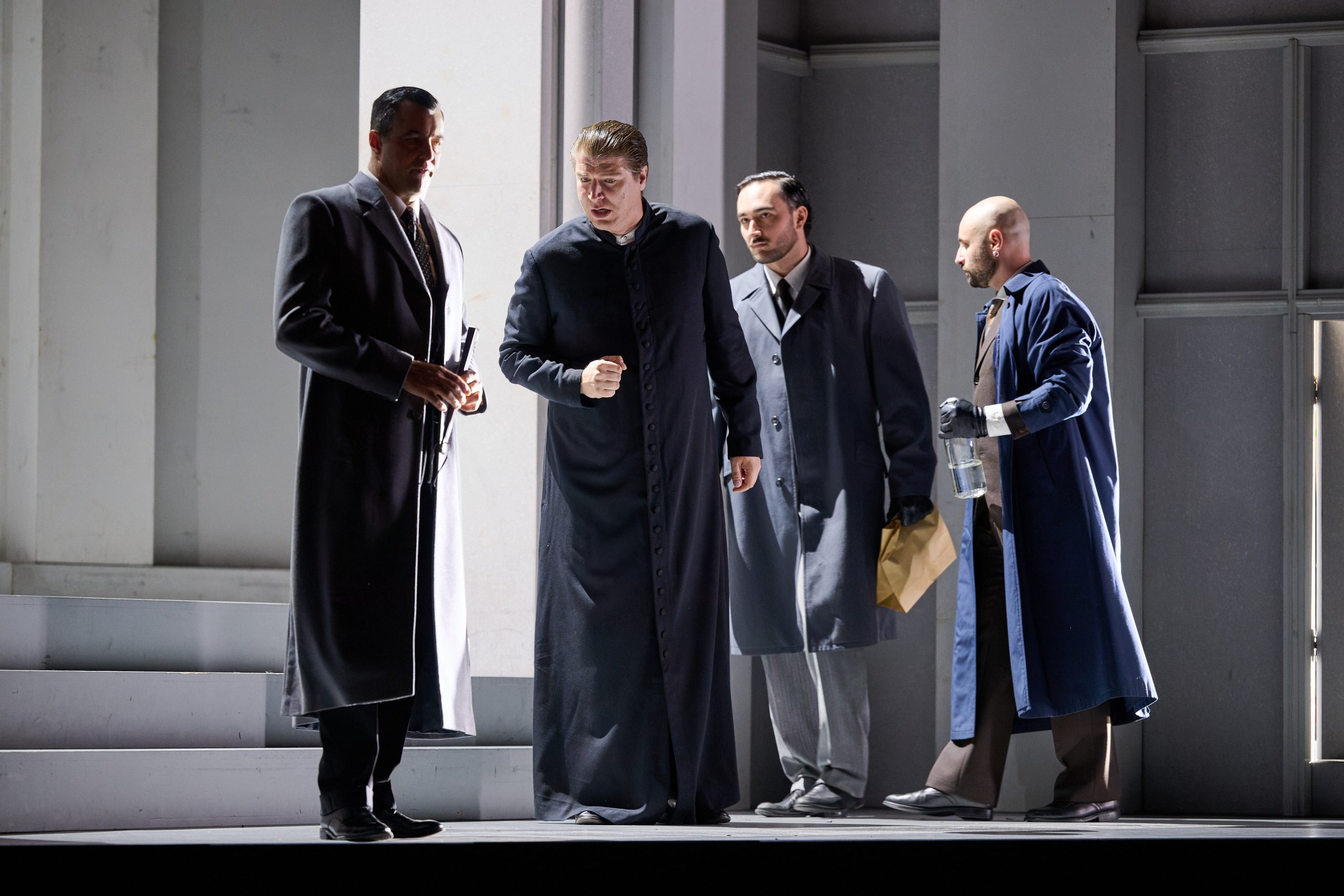
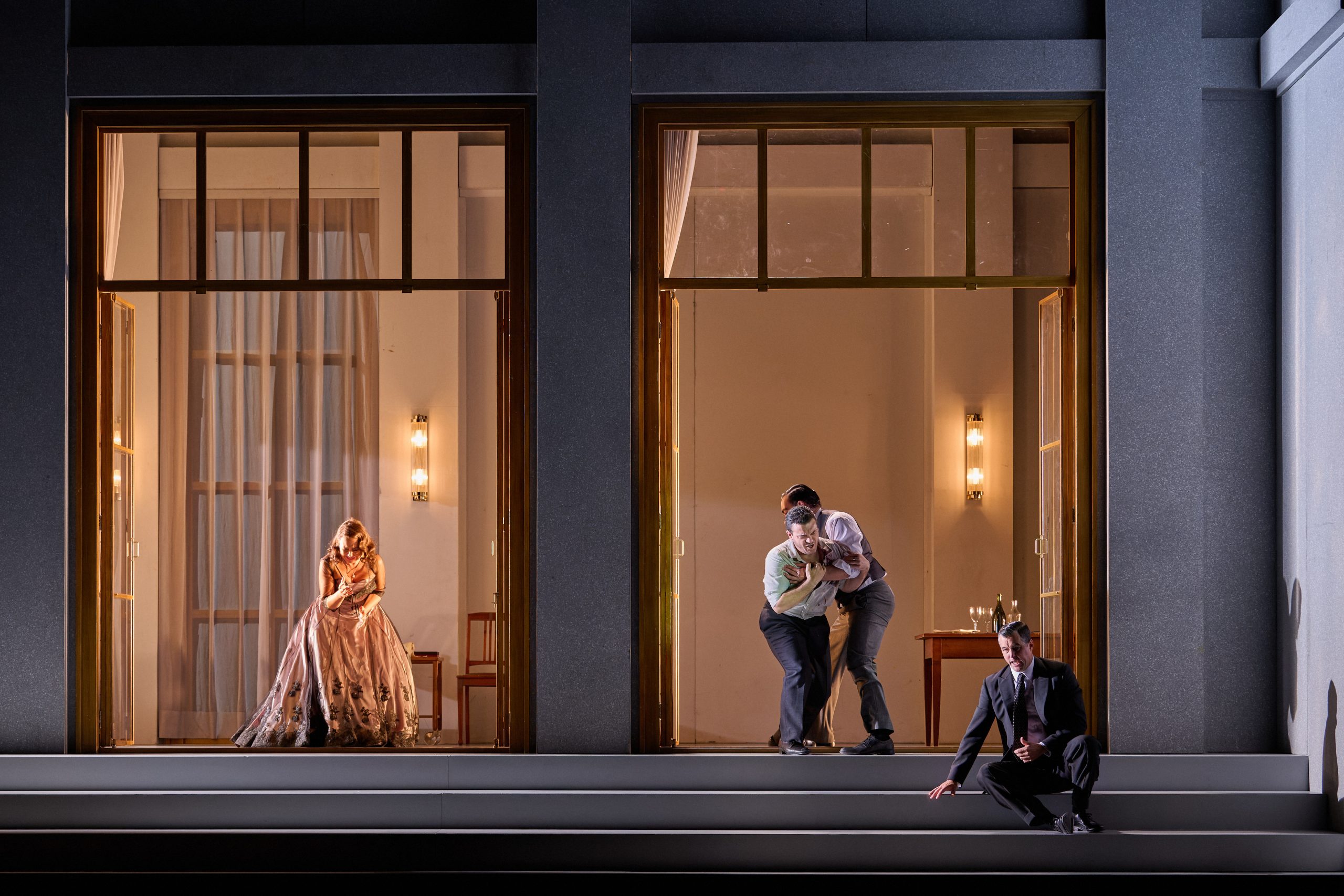
The settings themselves offer little sense of Puccini’s Rome, with its church, palace and fortress. Instead, we find anonymous spaces that could belong almost anywhere. The opening scene is set against grey walls, a few steps and a solitary ladder. Cavaradossi’s painting of Mary Magdalene remains on a wall hidden from the audience, leaving even those blue eyes entirely to our imagination. The Sacristan’s attire and the objects he carries provide the few visual clues that we are inside a church. Scarpia’s quarters, meanwhile, resemble a penthouse, with large glass doors opening onto a few steps outside. The arrangement places the audience outside the residence, looking into its sparsely furnished rooms as though observing private events through the windows. We witness Cavaradossi’s torture much as Tosca does, catching only glimpses through the glass doors and curtains, while Scarpia’s murder unfolds inside the room, visible through the open glass doors.
photo©Janosch Abel
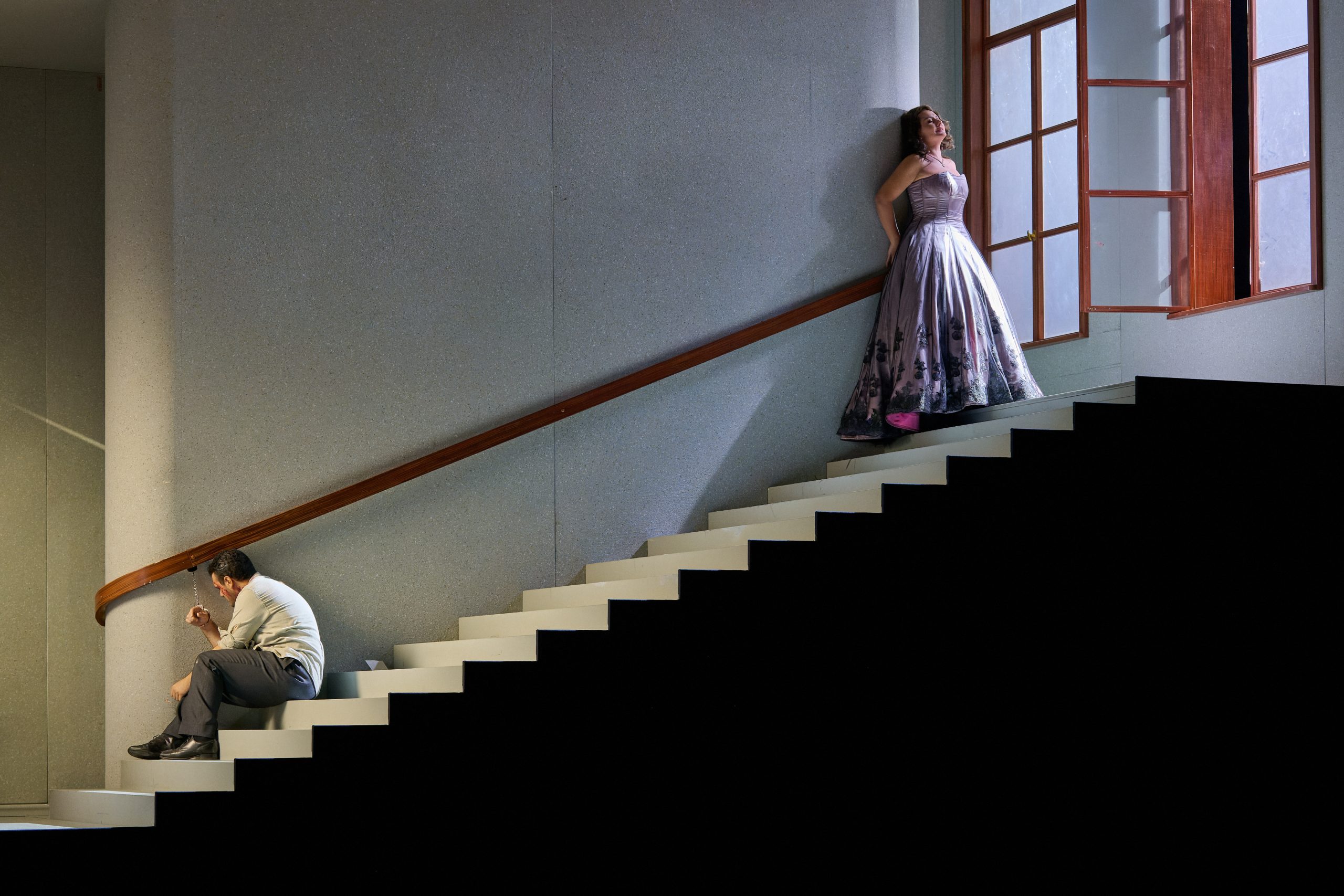
The final act unfolds on the staircase of an unknown building, where even the jailer resembles a porter rather than a prison guard. Cavaradossi’s death takes place entirely out of sight, in a room off the staircase, shifting the dramatic focus to Tosca, whose reactions become our immediate connection to what has happened. Only when she tries to wake him does the upper half of his body come into view through the doorway. Scarpia’s men wipe the pistol clean and place it on his body, while the jailer accepts a small bribe for his silence. Voigt transforms the execution into something closer to a concealed murder, with little sense of military formality or public authority.
This selective visibility can be intriguing, inviting the audience to piece together events from glimpses rather than witnessing them directly. Yet the approach is not always effective. Unlike in cinema, where the director controls what the viewer sees, in theatre the visual experience also depends on where one is seated. At times, particularly in the first act, the positioning of the performers seems to obstruct the view without adding much to the dramatic impact.
Voigt’s interpretation, however, extends beyond the visual setting. His direction of the characters, particularly Scarpia, unsettles the familiar balance of power between the protagonists.
photo©Janosch Abel
At the emotional centre of the production is Olga Busuioc’s Tosca, moving between fierce jealousy and anger, tenderness and devotion, and ultimately desperation. With a commanding stage presence and beautiful vocal timbre, Busuioc captures attention from her first notes. In a production where much of the action is concealed or only partly visible, her reactions become an essential part of the storytelling. She brings energy and emotional debth to the role. Her jealousy has an almost impulsive intensity, while her exchanges with Cavaradossi reveal warmth, affection and passion. Her secure upper register and expressive phrasing support this dramatic range, while Vissi d’arte is delivered with tenderness and melancholy.
Her confrontation with Scarpia reveals another dimension of her interpretation. Faced with his unpredictable behaviour, Busuioc responds with spontaneity, shifting between fear, desperation and determination as she struggles to save Cavaradossi. Her horror at having killed Scarpia is equally convincing, and she sustains this dramatic intensity through to her final cry of “Scarpia, avanti a Dio!” as she leaps from the staircase window.
photo©Janosch Abel
Between these two emotionally turbulent figures, Joseph Dahdah’s Mario Cavaradossi provides a sense of stability. He combines tenderness and devotion with courage and defiance. In his exchanges with Tosca, Dahdah responds to her jealousy with a mixture of amusement and affection, their convincing chemistry bringing warmth to the relationship. His confrontation with Scarpia reveals his firmness, while the final act brings a change in his emotional state. Faced with what he believes to be the last moments of his life, his confidence gives way to a deeply moving display of vulnerability. Dahdah brings these contrasting emotions together with considerable dramatic conviction, complemented by a beautiful vocal timbre and an overall solid, expressive vocal performance.
Seth Carico’s Scarpia, however, turns the familiar dramatic balance almost upside down. Charismatic and commanding from his first appearance, Carico evokes the atmosphere of an old psychological thriller. Yet beneath this authority emerges a man fractured from within, consumed by desire, neurotic, restless and deeply unstable. At times, he seems almost afraid to confront his own reflection. His obsession with Tosca is accompanied by a strange fear of her, as though the woman he wishes to possess also threatens him. He moves between predator and prey, exercising power over others while increasingly becoming a prisoner of his own desires.
Voigt gives this contradiction visual expression at the close of the first act. The familiar religious procession of the Te Deum is absent. Instead, Scarpia lies on the floor, embracing a coat as though imagining Tosca in his arms. The chorus, including the children, gradually closes in around him, eventually forcing him back against the wall as their shadows rise above him. Carico’s portrayal captures this reversal: the man accustomed to dominating others now finds himself cornered and overwhelmed. Whether these shadows represent the weight of his deeds, his conscience or his darker impulses remains open to interpretation.
photo©Janosch Abel
In the second act, Carico develops this psychological instability through unpredictable shifts between aggression, nervous excitement and moments of almost complete emotional collapse. Even his cruelty towards Cavaradossi seems to offer a disturbing form of gratification. His impulsive movements and sudden changes of temperament occasionally approach the edge of excess, yet create a genuinely unsettling presence. Particularly revealing are the moments preceding his murder, when Scarpia becomes strangely passive, as though his desire to possess Tosca has transformed into a longing for her to take control. For a moment, the predator appears almost willing to become the prey. Carico’s warm vocal timbre provides an interesting contrast to the character’s darker impulses, while his assured vocal delivery and strong dramatic presence make Voigt’s interpretation particularly compelling.
The contrasting worlds of Cavaradossi and Scarpia are further defined by the characters around them. Christian Valle’s Sacristan brings warmth and a touch of humour to the opening scenes, particularly in his exchanges with the children. His assured stage presence and confident vocal delivery give the character a distinctive personality. William Meinert’s Angelotti, meanwhile, brings authority and dramatic conviction to his appearances, reinforcing the political tensions underlying the story.
Scarpia’s world is markedly colder. Fabio Dorizzi’s Spoletta and Dario Lupi’s Sciarrone reflect the threatening nature of his authority, both delivering convincing vocal and dramatic performances. A nicely observed detail is the way they turn away as Scarpia prepares to strike Cavaradossi, as though unwilling to witness their superior’s cruelty despite their own complicity. Iyad Dwaier gives an effective performance as the Jailer, while Artian Taipi’s Shepherd Boy brings a brief moment of lightness before the final tragedy.
From the pit, Carlo Goldstein leads the Bern Symphony Orchestra with energy and a clear sense of dramatic momentum. The orchestral playing is responsive, bringing out the changing colours of the music while maintaining close coordination with the stage. The Chor der Bühnen Bern and Kinderchor der Bühnen Bern contribute both musically and dramatically, particularly in the first-act finale, where their singing and stage presence add considerable weight to Voigt’s interpretation.
Ultimately, Voigt’s Tosca largely succeeds in realising its cinematic vision. The drama unfolds with the tension and momentum of a gripping film, keeping the audience engaged and often on edge. Not every visual choice is equally convincing, and the deliberate concealment of certain events and occasionally the performers themselves does not always achieve the intended effect. Yet the psychological interpretation, particularly of Scarpia, and the committed performances make for a compelling evening, despite some reservations about the staging.
Catrine N.Andro
Hotel Chateau Eniseli Bagrationi
Cristina Bersanelli